All guides · Knowledge
Property valuation in Germany: costs €0 to €5,000
Updated: 2026-07-12 · Reading time: 13 min · ImmoLens editorial team
Editorial & transparency
This guide was written by the ImmoLens editorial team and last reviewed on 2026-07-12. The information is for orientation and does not replace legal, tax or financial advice.
Whether you want to buy, sell or refinance a property, the property valuation is the pivot of every negotiation. But what is a property really worth? This guide explains how a valuation works step by step, which of the three standard methods applies when, what an appraisal costs, why Verkehrswert (market value) and Beleihungswert (mortgage lending value) are not the same thing, and where online valuations are reliably wrong.
1. How a valuation actually works
A professional valuation is not a glance at a portal but a procedure with fixed steps. Once you know the sequence, you also see where a quick online estimate takes a shortcut.
- Gather the documents. Land register extract, cadastral map, building drawings, the living space calculation, the energy certificate, proof of modernisations. For a condominium, additionally the Teilungserklärung (declaration of division), the minutes of the owners' meetings and the level of the maintenance reserve.
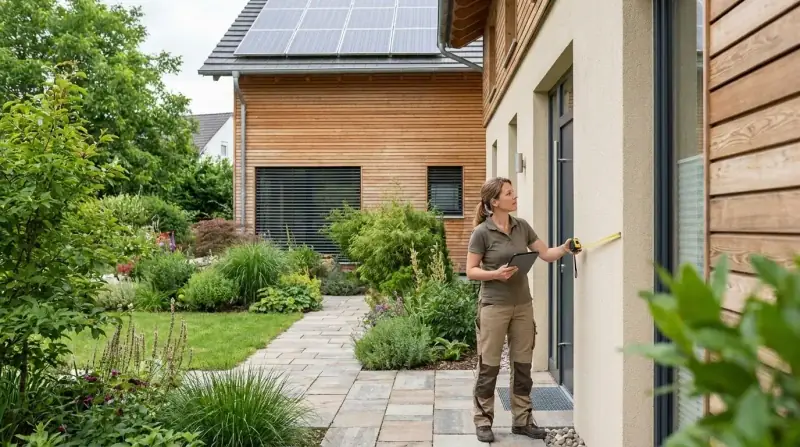
- Site visit. The surveyor inspects the building fabric, the condition of roof, windows and heating, damp, the layout and the noise situation. That is precisely what an algorithm cannot do.
- Obtain market data. The Bodenrichtwert (standard land value), the purchase price database, the Liegenschaftszins (property yield rate) and the Sachwertfaktor come from the municipal Gutachterausschuss (expert committee, § 192 BauGB). It is the only data source based on real, notarised purchase prices.
- Choose the method. Comparative, income or asset value method, depending on the type of property and the data available.
- Calculate and adjust to the market. The raw result is adjusted to the actual local market with market adjustment factors, then property-specific features are added or deducted (renovation backlog, right of residence, listed status).
- Report. The market value is justified in writing and derived transparently. Only that reasoning makes an appraisal defensible.
The legal basis is the BauGB (the federal building code) and the ImmoWertV (Immobilienwertermittlungsverordnung, the property valuation ordinance, in its new version since 2022). From the engagement to the finished full appraisal, several weeks usually pass, because obtaining documents and arranging the site visit take time.
2. The three valuation methods, and when each applies
| Method | Principle | Suitable for |
|---|---|---|
| Vergleichswert (comparative value) | What did similar properties in the area cost? | Condominiums (ETW), terraced houses, building plots |
| Ertragswert (income value) | What rental income does the property generate? | Let apartment buildings (MFH), commercial properties |
| Sachwert (asset value) | What does reconstruction cost (land + building)? | Detached houses (EFH), special properties, little comparable data |
Choosing the method is not a matter of taste, it follows the use of the property. The rule of thumb:
- Condominium: comparative value. In a city with many sales the data is good, and the method is then the most accurate one.
- Let apartment building or commercial property: income value. A buyer here is paying for a cash flow, not for bricks.
- Detached single-family house: asset value. Every house is different, genuine comparable properties are rare.
- A let single-family house: this is where it gets interesting. If owner occupation is the point, the asset value counts. If it was bought as an investment, the income value can be the more honest yardstick. Good appraisals calculate both and explain which one they follow.
3. Comparative value method and the Bodenrichtwert
The Vergleichswertverfahren is the most accurate method, provided sufficient comparable data is available. The Gutachterausschuss of each municipality collects all notarised purchase prices and publishes Bodenrichtwerte (standard land values) and Kaufpreissammlungen (purchase price databases) from them.
The Bodenrichtwert (§ 196 BauGB) is the average location value of the land per square metre for an area. It is determined at least every two years, in many federal states annually, and it is free to access: through the BORIS portals of the federal states (for example BORIS BW) or bundled nationally via BORIS-D.
4. Income value method: for investors
In the income value method, the sustainably achievable rental income is at the centre. The shorthand “rent times a multiple” is misleading, because land does not wear out and is therefore treated separately. The correct calculation runs like this:
| Annual gross income (net cold rent) | 24,000 € |
| − management costs (20 %) | 4,800 € |
| = net income | 19,200 € |
| Land value (400 m² × 300 €/m²) | 120,000 € |
| − Bodenwertverzinsung (3.5 %) | 4,200 € |
| = Gebäudereinertrag | 15,000 € |
| × multiplier (3.5 %, 40 years remaining useful life) | 21.36 |
| = building income value | 320,400 € |
| Ertragswert (+ land value) | 440,400 € |
5. Asset value method: land plus building
The asset value method adds the land value and the building asset value. The latter is derived from the Normalherstellungskosten (standard construction costs, what the building would cost to build new today), minus the depreciation for age covering the useful life already consumed.
The decisive and usually overlooked step comes afterwards: the total is multiplied by the Sachwertfaktor, a market adjustment factor published by the Gutachterausschuss. It translates pure construction costs into what the local market actually pays. Depending on the location this factor is well below or well above 1.0. In a sought-after region the same structure can therefore be worth considerably more than in a shrinking one. An asset value without the Sachwertfaktor is not a valuation, it is a construction cost estimate.
6. Verkehrswert, market price, Beleihungswert: three numbers that are not the same
This section is the most important in the whole guide, because this is where most financings come apart. There is no single “value” of a property but at least three, and your bank calculates with a different one than you do.
| Term | What it means | Who uses it |
|---|---|---|
| Verkehrswert (market value) | The price achievable in ordinary business dealings on the valuation date (§ 194 BauGB). An objectified value derived by a surveyor. | Surveyors, courts, the tax office |
| Market price | What is actually paid. Bidding contests, time pressure or emotion can push it well above the Verkehrswert. | Buyers and sellers |
| Beleihungswert (mortgage lending value) | The value achievable durably, including in a downturn. Speculative elements must expressly be excluded (§ 16 PfandBG). | Your bank |
The bank does not finance on the basis of the purchase price but on the basis of the Beleihungswert. And that lies deliberately below it: banks apply a safety discount, often in the order of about 10 percent, and more for difficult properties. What that means in practice is shown by this calculation:
Example: the loan-to-value the buyer never saw coming
7. What does an appraisal cost, and when is it worth it?
| Type of appraisal | Cost | When it makes sense |
|---|---|---|
| Online valuation | 0 € (free) | First orientation, not admissible in court |
| Short appraisal (Kurzgutachten) | 500–1,500 € | Purchase negotiation, financing |
| Full appraisal (Verkehrswert) | 2,000–5,000 € | Divorce, inheritance, court, tax office |
| Building surveyor check | 400–800 € | Inspection of the building fabric before purchase |
A full appraisal costs money that almost always pays for itself in four situations:
- Inheritance and gifts. The tax office first values an inherited house in a standardised way, using the typified procedures of the Bewertungsgesetz (Valuation Act). If that value comes out too high, you pay too much inheritance tax. § 198 BewG expressly allows you to prove the lower actual value, and in practice that only works with an appraisal. For a house in need of renovation, this escape clause can save a multiple of the surveyor's fee.
- Divorce and the equalisation of accrued gains. As soon as two parties with opposing interests look at the same number, you need an independent, publicly appointed surveyor. Everything else ends up in court.
- Community of heirs. When one heir buys out the others, the Verkehrswert is the basis of the calculation. Without a neutral valuation, this question tears families apart.
- Financing a special property. For a listed building, a farm or a leasehold, the bank often wants to see a solid valuation before it will even make an offer.
8. How accurate are online valuations?
Online tools use statistical models (automated valuation models, AVM) based on asking price and transaction data. For a standard condominium in a city with many sales they deliver usable figures, with a typical deviation of ±10–20 %. Their principle is statistical comparison, and that is exactly where they fail as soon as there are no comparable properties.
For these special properties, an online valuation is practically worthless:
- Erbbaurecht (leasehold). You buy the building, not the land, and pay a ground rent indefinitely. The value is considerably below that of comparable full ownership. Most models simply ignore this.
- A right of residence or Nießbrauch (usufruct) in the land register. A lifelong right of residence reduces the value massively and is captured by no AVM.
- Listed buildings. Attractive for tax purposes, but expensive in the renovation conditions imposed and restricted in resale.
- Rural areas with few transactions. Without comparable cases the model extrapolates from other regions.
- A heavy renovation backlog. A model sees the year of construction and the floor area, not the wet cellar and the boiler from 1994.
9. Factors that reduce and increase value
⬇️ Reduces value
- Renovation backlog (roof, windows, heating)
- Poor energy efficiency class (G/H)
- Noise pollution (road, railway, airport)
- North-facing orientation / little light
- Contamination in the soil
- Leasehold, right of residence, right of way
⬆️ Increases value
- Recently renovated (bathroom, kitchen, heating)
- Good energy efficiency class (A/B)
- Quiet location with good infrastructure
- South-facing balcony / garden
- Parking space / garage
- A plot that can be divided or built on more densely
10. The five most common valuation mistakes
- Mistaking asking prices for purchase prices. What stands in the portal is a demand. What the Gutachterausschuss collects are notarised facts. The gap between them is your negotiating room. More on this in the guide Property prices 2015 to 2026.
- Taking the living space from the Exposé at face value. Under the Wohnflächenverordnung (living space ordinance), areas under sloping ceilings only count in part and balconies usually count as a quarter. Anyone calculating to DIN 277 arrives at considerably more square metres. With a price per square metre, this definition decides tens of thousands.
- Overvaluing modernisations. A new kitchen for 25,000 € does not raise the market value by 25,000 €. What is relevant to value is what extends the remaining useful life: roof, windows, heating, pipework. Not the looks.
- Forgetting the Beleihungswert. See section 6. That mistake costs you no value, it costs you interest.
- Relying on a single number. A serious result is a range. Anyone who gives you the value to the exact euro is selling you a certainty that does not exist.
11. Frequently asked questions about property valuation (FAQ)
How much is my house worth, and which method applies?
That is decided by how the property is used, not by preference. A condominium in a city with many sales is captured most accurately by the comparative value, a let apartment building by the income value, a detached single-family house usually by the asset value. For a let single-family house it pays to ask for both calculations and for the reasoning behind the one the surveyor follows. Expect a range as the result, not a figure down to the euro.
What does a property appraisal cost in Germany?
Between 500 and 5,000 €, depending on the depth. A short appraisal for a price negotiation or a financing application comes to 500–1,500 €, a full appraisal of the Verkehrswert to 2,000–5,000 €. Having a building surveyor check the fabric before purchase costs 400–800 €, and an online valuation is free. For the tax office, the courts, a divorce or a community of heirs, only the full appraisal works, prepared by a publicly appointed and sworn surveyor or one certified to DIN EN ISO/IEC 17024.
What is the Bodenrichtwert, and where do I get it?
It states what one square metre of land in a defined area is worth on average, anchored in § 196 BauGB. The Gutachterausschüsse update it at least every two years, in many federal states annually, and publish it free of charge through the BORIS portals of the states. Do not simply multiply it by your plot size: the figure describes a notional reference plot. Very large, narrow or sloping plots come out below it per square metre.
How is the Bodenwertverzinsung calculated in the income value method?
Land value multiplied by the Liegenschaftszins. In the worked example above, 400 m² at 300 €/m² give a land value of 120,000 €, and at a Liegenschaftszins of 3.5 % that is 4,200 €. Deducted from the net income of 19,200 €, a Gebäudereinertrag of 15,000 € remains, which the multiplier of 21.36 turns into 320,400 €, so 440,400 € including the land value. The extra step is needed because land, unlike the building, has no limited useful life.
How accurate are free online valuations?
For a standard condominium in a city with many sales, the typical deviation is ±10–20 %. These models work purely statistically. Once comparable cases are missing, the result loses its basis: leasehold, a registered right of residence, listed status, thinly populated regions and a heavy renovation backlog are barely reflected at all. Note as well that many portals evaluate asking prices rather than the notarised purchase prices held by the Gutachterausschuss.
Why does my bank use a lower value than the purchase price?
Because what counts for the bank is the Beleihungswert, the value achievable durably even in a downturn under § 16 PfandBG. A safety discount of around 10 percent is customary. On a purchase price of 400,000 € with a 320,000 € loan you assume you are an 80 percent case, while the bank calculates against 360,000 € and arrives at 89 percent, with the interest premium attached. Plan against the reduced value from the start. What total is affordable is shown by the budget calculator.
Estimate the property value with AI
ImmoLens analyses the data in the Exposé (property brochure) and compares it automatically with regional market data, for a well-founded assessment of whether the price is appropriate.
Analyse an ExposéThe next step for your property
Check your listing for free with AI: renovation costs, funding programmes and risks in a few minutes. Start your analysis, or use the free tools: Closing cost calculator, Budget calculator, Viewing checklist.