All guides · Knowledge
Energieausweis explained in English: buyer's guide
Updated: 2026-07-28 · Reading time: 15 min · ImmoLens editorial team
Editorial & transparency
This guide was written by the ImmoLens editorial team and last reviewed on 2026-07-28. The information is for orientation and does not replace legal, tax or financial advice.
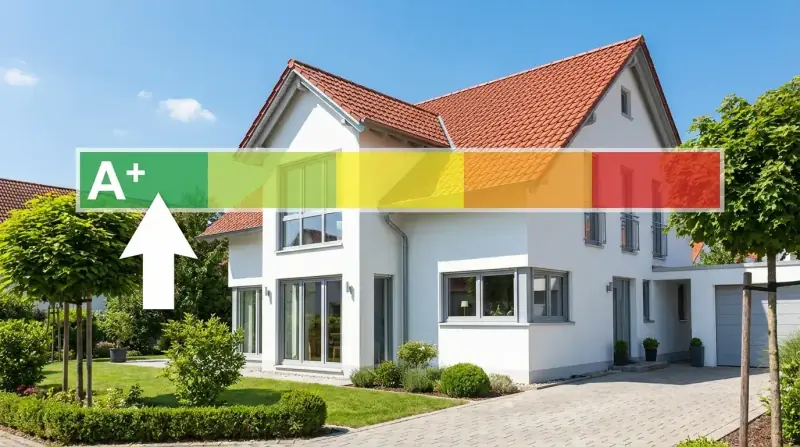
The Energieausweis (energy performance certificate) is the only document in a German listing that puts a number on a building's energy efficiency. That is exactly why it gets misread. It says less than most buyers think, and in other places it says more than the seller would like. This guide explains which type of certificate is mandatory when, why a consumption-based certificate reflects the previous occupants' heating habits, how to turn the efficiency class into a euro figure, and where the certificate systematically misleads.
1. Two types of certificate, and only one is objective
Under § 79 (1) GEG an energy certificate may be issued either as an Energiebedarfsausweis (demand-based) or as an Energieverbrauchsausweis (consumption-based). The difference is not a formality. It decides whether the number on page 1 says something about the building or about the people who lived in it.
| Feature | Verbrauchsausweis (consumption) | Bedarfsausweis (demand) |
|---|---|---|
| Basis | Heating bills covering 36 consecutive months (§ 82 (1) GEG) | Calculated demand from building elements, insulation and plant technology |
| Informative value | Low, depends on how the occupants behaved | High, standardised boundary conditions |
| Cost | around €50 to €100 | around €300 to €500 |
| Legal status | Merely permitted, never prescribed | Mandatory in the cases of § 80 (1) to (3) GEG |
| Typical error | A frugal previous owner produces a value that is too good | None, but it costs more and takes longer |
The direction of the rule matters. The consumption-based certificate is never mandatory, it is only allowed. What the law prescribes is always the demand-based certificate, in three cases: for a new build (§ 80 (1) GEG), after a major modification with a fresh calculation (§ 80 (2) GEG), and in the case that concerns buyers of older properties.
2. Why the consumption certificate measures the previous occupant
§ 82 GEG requires bills from a consecutive period of 36 months, the most recent of which may not be older than 18 months. Two corrections are prescribed: heating energy consumption is adjusted for the weather, so that a mild winter does not flatter the result, and prolonged vacancy is taken into account in the calculation.
Both of these correct for the weather and for the empty flat. There is no correction for heating behaviour. Someone who keeps the living room at 19 rather than 22 degrees, who never heats the bedrooms, who spends half the year at their children's place: all of that pushes the figure down without adding a single centimetre of insulation. As a rough orientation, building physics assumes that one degree less room temperature cuts heating energy by around six percent. Three degrees of difference in behaviour therefore shift the figure by roughly a fifth, and that is already a full efficiency class.
3. Duty to present, mandatory details in the ad, and the fine
The Energieausweis is not a courtesy of the seller. The GEG regulates the timing and the form:
- No later than the viewing, the seller, landlord or the agent instructed by them must present the certificate or a copy without being asked (§ 80 (4) GEG). If there is no viewing, it must be presented without delay on request.
- Immediately after the contract is concluded, the certificate must be handed over to the buyer. The same applies to letting, leasing and similar arrangements (§ 80 (5) GEG).
- Every commercial property advertisement must contain the mandatory details under § 87 GEG, provided a certificate exists: the type of certificate (demand or consumption), the final energy figure, the main energy source of the heating system, and for residential buildings additionally the year of construction and the energy efficiency class.
4. Validity, exemptions, and who may issue it
Under § 79 (3) GEG an energy certificate is issued for ten years. It loses its validity earlier if a modification to the building makes a new certificate necessary. A certificate from 2015 has therefore expired in 2026, and the seller has to obtain a new one before advertising.
§ 79 (4) GEG names two exemptions: the provisions on the energy certificate do not apply to a small building, and for a listed monument the duties to present and hand over do not apply. Anyone buying a listed building may therefore receive no certificate at all and has to commission the energy assessment themselves.
Only those authorised under § 88 GEG may issue an energy certificate. The section lists the permitted qualifications exhaustively: persons entitled to submit building documents, graduates of relevant degree courses (architecture, civil engineering, physics and related subjects) with further training or professional experience, master craftspeople from the construction, installation and chimney-sweep trades with the corresponding further training, state-recognised technicians, and persons who have passed the energy consultancy examination of the Federal Office for Economic Affairs and Export Control. A pure online provider without those qualifications does not issue a valid certificate.
5. The efficiency classes A+ to H
The classes are set out in Anlage 10 of the GEG. The reference quantity is decisive, and it is almost always misunderstood: the yardstick is the final energy in kilowatt hours per square metre of Gebäudenutzfläche (building usable floor area) per year. Not the primary energy, and not the living area.
The step from class D to class H costs around €2,400 per year in this calculation, so over a 20-year holding period roughly €48,000, with no price increases factored in at all. That is not a minor item, that is a small car every ten years.
6. From the class to the euro figure
The calculation itself is trivial. The errors sit in the two input figures.
Trap 2, the price. The efficiency class says nothing about what the building is heated with, yet it is precisely the energy source that determines the bill. Two houses with an identical figure and an identical class can differ in annual cost by a factor of three:
| Energy source | Price per kWh | Source |
|---|---|---|
| Natural gas | around €0.12 | Destatis: 12.23 ct/kWh for households, second half of 2025 |
| Household electricity (direct or storage heating) | around €0.41 | Destatis: 40.55 ct/kWh for households, second half of 2025 |
| Heat pump electricity (separate meter, reduced grid fee) | around €0.28 | Typical market range for heat pump tariffs, no official statistic |
| Gebäudenutzfläche per the certificate | 156 m² |
| Final energy: 145 × 156 | 22,620 kWh/year |
| Cost with gas heating (€0.122/kWh) | €2,760/year |
| Cost with night storage heating (€0.406/kWh) | €9,180/year |
Same class, same figure, same house. The difference of €6,400 a year lies solely in the energy source. On its own, the efficiency class is therefore not a statement about costs.
7. Why a heat pump lifts the class without any insulation
Because Anlage 10 GEG is tied to the final energy and not to the heat demand of the building envelope, replacing the heating system improves the class dramatically even if not a single window has been changed. A heat pump delivers two to four times as much heat as the electricity it consumes. The final energy supplied falls accordingly, and the figure falls with it.
The same terraced house as above, insulation unchanged, only with a different heating system:
| Final energy with a gas boiler | 22,620 kWh |
| of which useful heat (boiler efficiency 90 %) | 20,358 kWh |
| Electricity needed by the heat pump (seasonal performance factor 2.5) | 8,143 kWh |
| new figure: 8,143 / 156 | 52 kWh/m²a, class B |
| Electricity costs (€0.28/kWh) | €2,280/year |
From class E to class B, without a single square metre of insulation. The running costs only fall from €2,760 to €2,280, that is by around 17 percent.
8. The CO2 price comes on top
Since 2021 the German national fuel emissions trading scheme has made fossil heat more expensive. § 10 BEHG sets the prices: €25 per tonne of CO2 in 2021, €30 in 2022 and 2023, €45 in 2024, €55 in 2025. For 2026 the fixed-price phase ends. Certificates are auctioned, within a price corridor of €55 to €65 per tonne.
| Year | CO2 price (§ 10 BEHG) | Surcharge on gas | Surcharge on heating oil |
|---|---|---|---|
| 2024 | €45/t (fixed) | 1.1 ct/kWh | 14 ct/l |
| 2025 | €55/t (fixed) | 1.3 ct/kWh | 17 ct/l |
| 2026 | €55 to €65/t (corridor) | 1.3 to 1.6 ct/kWh | 17 to 21 ct/l |
The surcharges are calculated with the usual emission factors of around 0.201 kg CO2 per kilowatt hour of natural gas and around 2.66 kg CO2 per litre of heating oil, each plus 19 percent VAT. For the terraced house in section 6, with 22,620 kWh of gas a year, that is about 4.5 tonnes of CO2 and therefore €300 to €350 in CO2 costs alone, already contained in the gas price. Forecasts beyond 2026 are uncertain: the European emissions trading scheme for buildings and transport is to replace the national system, but the start date and the price mechanism are still being negotiated politically. Only the direction is dependable, not the number.
9. What the Energieausweis does not tell you
This section is the most important one, because it clears up the most common false assumption when buying: the Energieausweis is not a condition report. It does not replace a building surveyor, and it explicitly says nothing about:
- The condition of individual building elements. The certificate makes no statement about whether the roof is watertight, whether the windows still close, or whether the façade has cracks. It works with characteristic values, not with what a surveyor sees.
- Damp, mould, pests. A wet cellar does not appear in the energy certificate. A house in class C can carry €40,000 of cellar damage.
- The quality of the workmanship. Thermal bridges, leaky joints and shoddy work are estimated in a lump-sum way in the demand-based certificate, not measured.
- The consumption you will actually have. The demand-based certificate assumes standardised boundary conditions (room temperature, ventilation, use). Your real consumption regularly deviates from it, in both directions.
- The remaining service life and maintenance state of the heating system. The certificate names the year and the type, but not whether the boiler will fail tomorrow.
10. The six traps when buying
- A consumption certificate for an unrefurbished pre-war or post-war building. With fewer than five flats and a building application filed before 1 November 1977, it is inadmissible under § 80 (3) GEG unless the house has been brought up to the standard of the 1977 Wärmeschutzverordnung. Ask for proof of that refurbishment if a consumption certificate is presented anyway.
- Multiplying the figure by the living area. The reference quantity is the Gebäudenutzfläche, which is around a fifth larger. The error makes the heating costs about 20 percent too small.
- Confusing class with cost. A class E house with night storage heaters costs more than three times a class E house with gas.
- An expired certificate. Ten years, not a day longer. Check the date of issue on page 1.
- A good class thanks to a heat pump, and a poor envelope. The class measures the final energy, not the insulation.
- Reading the certificate as a condition report. It is a calculation sheet, not a survey. For the building fabric you need a separate appointment with a surveyor.
11. The Energieausweis in English: the terms translated
International buyers receive the same German certificate as everyone else. That is workable, because the parts that decide a purchase are figures, classes and a fixed set of technical terms. Once you know the nine fields in this table, you can check a certificate without reading a line of the German body text.
| Field on the certificate | In English | What it tells you |
|---|---|---|
| Energiebedarfsausweis | demand-based certificate | Calculated from the building, comparable across properties (section 1) |
| Energieverbrauchsausweis | consumption-based certificate | Taken from the previous occupants' bills, so it describes their habits |
| Endenergie | final energy | The figure in kWh/(m²a) that the efficiency class is keyed to |
| Primärenergie | primary energy | Rates the supply chain of the energy source, not your heating bill |
| Gebäudenutzfläche | reference floor area | The reference for the figure, around a fifth larger than the living area |
| Energieträger | energy source | Gas, oil, district heating or electricity: this sets the cost per kWh |
| Effizienzklasse | efficiency class | A+ to H under Anlage 10 GEG, based on the final energy |
| Ausstellungsdatum | date of issue | On page 1, the certificate is valid for ten years (§ 79 (3) GEG) |
| Modernisierungsempfehlungen | modernisation recommendations | Last page, signed by the issuer: your negotiating argument |
Two of these fields still need context, because they are routinely misread: the figure refers to the Gebäudenutzfläche and not to the living area (section 6), and the efficiency class measures the final energy and not the insulation (section 7).
12. Further reading
- Gebäudeenergiegesetz (GEG), full text
- § 10 BEHG, CO2 prices and price corridor
- Destatis, gas and electricity prices for households
- Verbraucherzentrale, the Energieausweis explained
Have your Energieausweis evaluated automatically
Upload your Energieausweis as a PDF. ImmoLens reads out the figure, the class and the energy source, and works through heating costs, refurbishment costs and funding potential.
Upload the EnergieausweisThe next step for your property
Check your listing for free with AI: renovation costs, funding programmes and risks in a few minutes. Start your analysis, or use the free tools: Closing cost calculator, Budget calculator, Viewing checklist.