All guides · Strategy
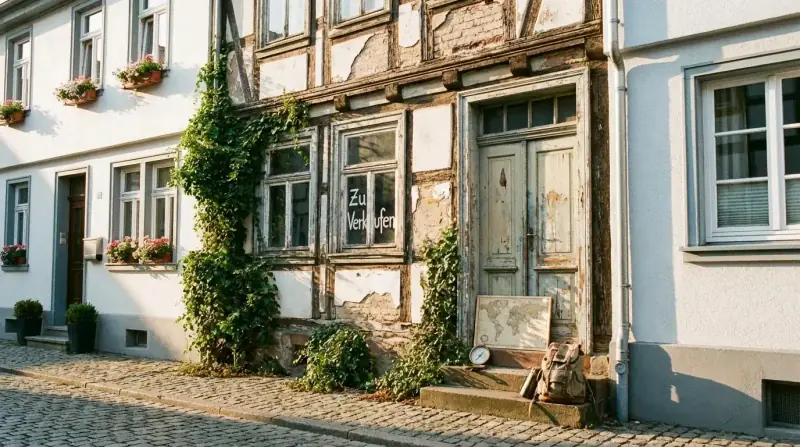
Buying property below market value in Germany: renovation backlog, auctions, off-market
Updated: 2026-09-10 · Reading time: 13 min · ImmoLens editorial team
Editorial & transparency
This guide was written by the ImmoLens editorial team and last reviewed on 2026-09-10. The information is for orientation and does not replace legal, tax or financial advice.
Buying below market value does not mean taking anyone for a ride. It means paying a price that reflects the actual condition of the property while other bidders are still looking at the photos. This guide walks through the channels where that is realistically possible, works the most important case (the renovation backlog) through end to end, explains the Zwangsversteigerung (forced auction) with all its traps, and names the things you as a buyer must never do.
1. The benchmark: market value is not the asking price
"Below market value" is only a meaningful statement if you know the market value. German law defines it in § 194 BauGB: the Verkehrswert is the price that would be achieved in ordinary commercial dealings, given the legal circumstances and the actual characteristics of the property, disregarding unusual or personal circumstances. The asking price in a portal is none of that. It is a demand.
Three sources move you closer to the real value, and all three are open to you:
| Source | What you get | Legal basis |
|---|---|---|
| Bodenrichtwert (indicative land value) | The value of the bare plot per m². Determined at least every two calendar years, and anyone may request the figure from the office of the Gutachterausschuss (valuation committee) | § 196 BauGB |
| Kaufpreissammlung (register of actual prices) | The prices that were actually notarised, not the prices people hoped for. The Gutachterausschuss keeps and evaluates it, and the market reports are usually public | § 193 BauGB |
| Comparable listings | Asking prices of similar properties. The weakest anchor, because it sits systematically above the transaction prices | none, pure market observation |
The single most important distinction in this field: an asking price is not a transaction price. Anyone deriving their "market value" from portal listings is comparing demands with demands.
2. Renovation backlog: the strongest price argument, fully worked through
A renovation backlog is the only reason for a discount that you can back up with invoices. Location is arguable, two written contractor quotes are not. The calculation you have to make is always the same one:
A concrete example. An end-of-terrace house from 1978, 130 m², oil boiler from 1993, windows from 1990, undressed attic floor, original wiring. Asking price: 340,000 €. According to the Gutachterausschuss, comparable houses in the same street that have already been renovated change hands at around 355,000 €.
| Measure | Cost | Funding | Your share |
|---|---|---|---|
| Heat pump instead of the oil boiler | 32,000 € | 15,000 € | 17,000 € |
| 14 windows | 22,000 € | 3,300 € | 18,700 € |
| Top-floor ceiling insulation (100 m²) | 5,000 € | 750 € | 4,250 € |
| Complete rewiring | 12,000 € | 0 € | 12,000 € |
| Bathroom | 15,000 € | 0 € | 15,000 € |
| Total | 86,000 € | 19,050 € | 66,950 € |
Heat pump: 30 % base funding plus the 20 % Klimageschwindigkeits-Bonus for replacing an old oil heating system, calculated on the eligible cost ceiling of 30,000 € for the first residential unit (KfW 458). Windows and ceiling: BAFA single measures, 15 % base funding, plus 5 points on the cost above €30,000 with an individual renovation roadmap (iSFP). Wiring and bathroom are not energy measures and therefore not eligible.
On top of the 66,950 € you carry yourself comes a 15 percent risk buffer, around 10,000 €. That fixes your maximum purchase price: 355,000 € − 66,950 € − 10,000 € = roughly 278,000 €. Against the asking price of 340,000 € that is 62,000 € or 18 percent that has to come off. If the seller only moves 15,000 €, the property is not a bargain for you. It is a documented loss-making deal, and you can walk away with a clear conscience.
3. Time on the portal: the signal nobody can hide
A listing that has been running for six months has already tested the market and lost. The price was too high, the property has a flaw, or both. For you this is the cheapest information available, because it costs nothing and the seller knows you have it.
- Read the listing age: portals show the date the listing went live, some also show the price history. A price cut that has already happened is an admission that the starting price was wrong.
- Wait for the second cut: sellers rarely cut only once. After a first cut has failed, the willingness to defend the original price drops sharply.
- Do not assume the opposite: a long listing time can also mean the property has a defect you have not found yet. First work out why nobody is taking it, then negotiate.
4. Motivations: heirs, divorce, insolvency
In these three constellations the seller is not optimising for the highest price but for closure. An Erbengemeinschaft (community of heirs) has to reach agreement, a separating couple wants to close the chapter, an insolvency administrator owes a duty to the estate and has to realise assets promptly. That moves the price, but it does not move it without limit.
What you offer here is certainty instead of money: a written financing commitment from your bank, an early notary appointment, no withdrawal clauses, a flexible handover date. For a community of three heirs who cannot agree, a buyer who is guaranteed not to drop out is genuinely worth more than a buyer who offers 5,000 € more on shaky financing.
5. Zwangsversteigerung: procedure, limits, real cost
The forced auction is the only channel in which the price is not negotiated but discovered. The local courts publish the dates free of charge on zvg-portal.de . Commercial providers repackage the same dates and charge for them. They are not official.
The two value thresholds
The court sets a Verkehrswert, and two protective thresholds for the debtor and the creditors hang on that figure:
- The 5/10 threshold (§ 85a ZVG): the award must be refused if the highest bid does not reach half the value of the property. The court applies this of its own motion, nobody has to ask for it.
- The 7/10 threshold (§ 74a ZVG): if the highest bid stays below seven tenths of the value, a creditor who would otherwise go unpaid can apply for refusal. But he has to actually apply.
- At the second date both fall away. § 85a Abs. 2 and § 74a Abs. 4 ZVG state expressly that at the new auction date the award may no longer be refused on these grounds. That is where the deep prices arise, and that is also where the competition will be waiting.
What you have to bring
A party to the proceedings may demand a Sicherheitsleistung (security deposit, § 67 ZVG), and in practice one always does. The amount is fixed by law: one tenth of the assessed Verkehrswert (§ 68 Abs. 1 ZVG). Important, because it throws bidders out of the room every year: payment in cash is excluded (§ 69 Abs. 1 ZVG). What is accepted is a Bundesbank cheque or a crossed cheque issued no earlier than the third working day before the auction, an unlimited, unconditional and self-liable bank guarantee, or a transfer credited to the court's account before the auction.
What a 70 percent award really costs
| Highest bid | 210,000 € |
| Grunderwerbsteuer (property transfer tax, BW, 5.0 %) | 10,500 € |
| Interest on the Bargebot, 4 % for the 3 months until the distribution hearing | 2,100 € |
| Court fees for the award and the distribution | per GKG, value-dependent |
| Total (excluding court fees) | 222,600 € = 74.2 % of the Verkehrswert |
The Bargebot (the cash portion of the bid) bears interest from the award onwards (§ 49 Abs. 2 ZVG). The ZVG names no rate, so the statutory rate of four percent per year applies (§ 246 BGB). In exchange, agent commission and notary fees for the purchase contract disappear entirely: the award decision replaces the conveyance, and with it you become the owner directly (§ 90 Abs. 1 ZVG).
The four risks that can eat the discount
- No right to view. As a rule the debtor still lives in the house and does not have to let you in. The court's valuation report is often the only look inside you will get, and it can be one or two years old.
- No warranty. § 56 sentence 3 ZVG is unambiguous: "Ein Anspruch auf Gewährleistung findet nicht statt" (no warranty claim exists). Damp cellar, dry rot, broken heating: all your problem, from the second of the award. With the award, benefits and burdens also pass to you (§ 56 sentence 2 ZVG).
- The debtor still has to move out. The award decision is an enforcement title for eviction against the possessor (§ 93 Abs. 1 ZVG), but you have to run the eviction through a bailiff and pre-finance it. Expect months and a four-figure bill.
- Tenants stay. An existing tenancy continues. You only get a special right of termination at the first permissible date, observing the statutory notice period (§ 57a ZVG), and you have to exercise it immediately or it is spent.
6. Partition auctions, insolvency, municipal properties
The Teilungsversteigerung (partition auction) runs through the same courts and the same portal, but has a different trigger: co-owners, usually after a divorce or within a community of heirs, cannot agree and have the co-ownership dissolved. Because such properties are less well known, the field of bidders is often thinner. Do expect the co-owners themselves to bid, with an information advantage you do not have.
In insolvencies, the administrator realises the estate. He is interested in a swift, legally safe sale, not in the last euro. The proceedings are listed at insolvenzbekanntmachungen.de . Here too the warranty is regularly excluded. Finally, municipalities sell building land and existing properties partly below value, but tie that to conditions such as an obligation to build, owner occupation, or Einheimischenmodelle (local resident schemes). Ask the municipal administration directly, these offers rarely reach the portals.
7. Bidding procedures and off-market
In a Bieterverfahren the agent names no price and collects offers instead. This is not a procedure under the ZVG, it is a pure marketing instrument with no statutory rules, and it can swing both ways. With strong demand it drives the price above market value. With weak demand the seller suddenly holds two offers and has to negotiate. Fix an upper limit on paper beforehand and do not move away from it in the room.
Off-market simply means the property was never advertised. Access runs through people, not portals: local agents, tradespeople, property managers, bank advisors. The price advantage comes from the absence of a bidding contest. Inspection of the Grundbuch in order to identify an owner is only granted on proof of a legitimate interest (§ 12 GBO), and a mere intention to buy is not enough. The legitimate route to the owner of a vacant house runs through the neighbourhood and the municipality, not through the land registry.
8. What you should never do as a buyer
| The request | Why you refuse |
|---|---|
| "Pay a reservation fee and we will hold the property" | On 20 April 2023 (I ZR 113/22) the Bundesgerichtshof held that a reservation fee agreed in standard terms unreasonably disadvantages the customer and is void. It amounts to a commission independent of success. You can reclaim money already paid, but better not to pay it at all. |
| "A deposit before the notary appointment" | A contract on the transfer of a property requires notarial recording (§ 311b Abs. 1 BGB). Before that, no obligation exists that a deposit could relate to. You would be paying into nothing. |
| "Part in cash, then we both save tax" | That is tax evasion, and it hits you twice: the recorded price is too low, so the contract is attackable as a sham transaction, and your bank will not finance the undeclared part. |
| "No surveyor needed, we agree anyway" | When buying from a private seller, liability for material defects is excluded in the contract almost every single time. The surveyor is the only party who can still find something before you sign. |
Checklist: buying below market value
Further links
- Official auction platform, zvg-portal.de
- Insolvency announcements, insolvenzbekanntmachungen.de
- The Zwangsversteigerungsgesetz (ZVG) in full
- Verbraucherzentrale, construction and property financing
- VPB, Verband Privater Bauherren (association of private builders)
Check the market value automatically
ImmoLens analyses every Exposé for market value, renovation need and hidden risks, so you know whether an offer really is a bargain.
Check an Exposé for market valueThe next step for your property
Check your listing for free with AI: renovation costs, funding programmes and risks in a few minutes. Start your analysis, or use the free tools: Closing cost calculator, Budget calculator, Viewing checklist.