All guides · Law
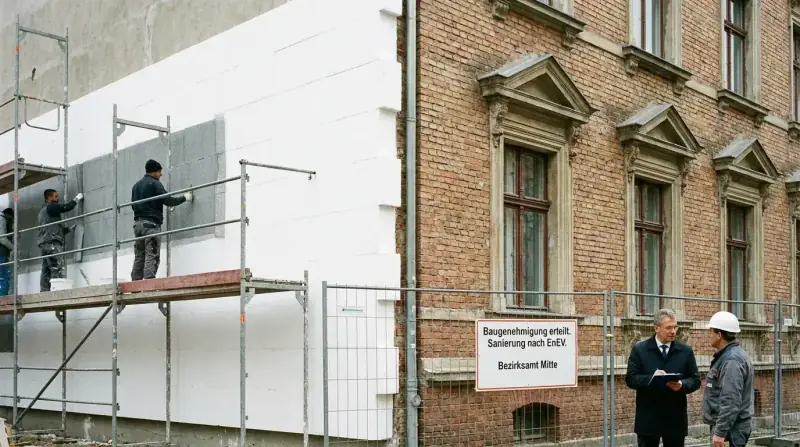
GEG 2026: 3 renovation obligations, €50,000 fines
Updated: 2026-09-15 · Reading time: 13 min · ImmoLens editorial team
Editorial & transparency
This guide was written by the ImmoLens editorial team and last reviewed on 2026-09-15. The information is for orientation and does not replace legal, tax or financial advice.
The Gebäudeenergiegesetz (GEG, the German Building Energy Act) obliges new owners to carry out certain energy-related renovations. Anyone buying an older house in 2026 needs to know these obligations, otherwise fines and unexpected costs follow. This guide explains the three retrofit obligations in detail, which deadlines apply, who can rely on the grandfathering rule and what the renovation costs mean for your price negotiation.
1. Who is actually affected?
The most important sentence first: the three retrofit obligations do not apply to every owner. There is an exemption that has protected many older buildings for decades, and that exemption ends with the sale.
Under § 73 GEG (and the equivalent rule in § 47 GEG for the top-floor ceiling): residential buildings with no more than two dwellings, one of which the owner occupied on 1 February 2002, are exempt from the obligations. So anyone who has lived in their own house since the 1990s has to neither replace the boiler nor insulate the ceiling.
This exemption is, however, attached to the person, not to the building. It does not pass to the buyer. The law words the deadline precisely: the new owner must fulfil the obligations within two years of the first transfer of ownership after 1 February 2002.
2. Obligation 1: Replacing the boiler (§ 72 GEG)
§ 72 GEG prohibits the continued operation of old boilers fired with liquid or gaseous fuel, meaning oil and gas. Two cut-off dates and one design type decide the matter:
- Boilers installed before 1 January 1991 may no longer be operated.
- Boilers installed on or after 1 January 1991 may run for 30 years from installation. A boiler from 1996 is therefore due in 2026.
- Only boilers with a rated output of 4 kW to 400 kW are affected. Smaller and larger systems fall outside the rule.
The point on which the question turns is the design of the boiler. The operating ban only hits Konstanttemperaturkessel (constant-temperature boilers), the old design that keeps the boiler contents permanently at a high temperature. Niedertemperaturkessel (low-temperature boilers) and Brennwertkessel (condensing boilers) are expressly exempt and may keep running even at 35 years of age.
| Boiler type | How to recognise it | Must be replaced? |
|---|---|---|
| Konstanttemperaturkessel | Usually built before about 1990, high boiler temperature, thick masonry chimney | Yes, after 30 years |
| Niedertemperaturkessel | Type plate, heating log, sliding boiler temperature | No, exempt |
| Brennwertkessel | Plastic flue pipe, condensate drain to the sewer | No, exempt |
3. Obligation 2: Insulating the top-floor ceiling (§ 47 GEG)
The oberste Geschossdecke (the topmost ceiling, towards an unheated attic) must be insulated so that its thermal transmittance does not exceed 0.24 W/(m²·K). Depending on the insulating material that means roughly 14 to 20 centimetres of insulation. Deadline after the change of ownership: two years.
The obligation also counts as fulfilled if the roof above is insulated to the same standard instead, or if the roof meets the minimum thermal protection of DIN 4108-2. So anyone with a converted, insulated attic has nothing to do.
| Variant | Cost/m² | Example 100 m² |
|---|---|---|
| DIY (laying out mineral wool) | 15–25 € | 1,500–2,500 € |
| Tradesperson (walkable panels) | 40–60 € | 4,000–6,000 € |
| Blown-in insulation | 20–35 € | 2,000–3,500 € |
4. Obligation 3: Insulating the pipes (§ 69 Abs. 2 GEG)
The third obligation is the least known and the cheapest. Under § 69 Abs. 2 GEG, previously uninsulated, accessible heat distribution and hot water pipes that are not located in heated rooms must be insulated. What is meant are the pipes running under the cellar ceiling. Unlike the boiler and the ceiling, the law grants no transition period here: the obligation exists as soon as the grandfathering falls away.
How thick the insulation has to be is set out in Anlage 8 of the GEG and depends on the inner diameter of the pipe (based on an insulating material of 0.035 W/(m·K)):
| Inner diameter of the pipe | Minimum insulation thickness |
|---|---|
| up to 22 mm | 20 mm |
| over 22 mm up to 35 mm | 30 mm |
| over 35 mm up to 100 mm | equal to the inner diameter |
| over 100 mm | 100 mm |
At wall and ceiling penetrations and where pipes cross, half the thickness is sufficient. For pipes exposed to outdoor air, double the thickness is required.
Material and effort are minimal: pre-slit insulation shells from the DIY store cost about 5–15 € per running metre if you fit them yourself. For a typical cellar that adds up to 200 to 500 €. Hardly any other obligation can be settled so quickly and so cheaply.
5. The 65 percent rule (§ 71 GEG) and municipal heat planning
The retrofit obligations only say that an old boiler has to go. What may go in is governed by a different section: § 71 GEG requires a newly installed heating system to use at least 65 percent renewable energy. For existing buildings, however, this duty is not switched on immediately but tied to the kommunale Wärmeplanung (municipal heat plan). Only once your municipality has presented its heat plan and designated an area does the 65 percent rule apply to new heating systems in existing buildings.
The Wärmeplanungsgesetz (Heat Planning Act) sets two deadlines for this. They decide whether the rule already applies to you today:
| Municipality | Heat plan due by | What it means for you |
|---|---|---|
| Over 100,000 inhabitants | 30 June 2026 | The deadline has passed, but the obligation is suspended until 1 November 2026 by the GModG reform and lapses once it enters into force |
| Up to 100,000 inhabitants | 30 June 2028 | Until then a pure gas or oil boiler is still legally possible as a replacement, but economically risky |
In practice the 65 percent are met with a heat pump, a district heating connection, biomass (wood pellets) or a hybrid of heat pump and peak-load boiler.
6. No obligation: facade, windows, cellar
Contrary to a widespread assumption, a change of ownership triggers no obligation to insulate the facade, replace the windows or insulate the cellar. Anyone buying a house with windows from 1985 may keep those windows for as long as they like.
Requirements only arise if you renew the component anyway. Then § 48 GEG applies: the new component must meet the maximum values of Anlage 7. What matters is the de-minimis threshold in the same section: changes affecting no more than 10 percent of the total area of the respective component group are exempt. So replacing two windows out of twenty triggers no GEG requirement. Reglazing the entire south side certainly does.
7. Enforcement, fines and exemption
Enforcement runs through the authorised district chimney sweep, who comes to the house for the statutory heating inspection anyway and checks compliance with the heating rules. If he finds a violation, he sets a deadline to remedy it. If nothing happens, the matter goes to the competent authority.
§ 108 GEG makes violations an administrative offence subject to a fine. For breaches of the retrofit obligation (§ 47) and the operating ban (§ 72) the framework reaches up to 50,000 €. That is the statutory ceiling, not the normal case: in practice the fines actually imposed on a single detached house are considerably lower. You should not rely on that, because the fine does not replace the obligation, it comes on top of it.
There are two ways out. § 102 GEG allows an exemption in cases of hardship if the requirements lead to unreasonable expense or undue hardship in the individual case. The application goes to the competent state authority, as a rule the untere Baubehörde (the lower building authority). In addition, § 47 GEG itself contains an economic viability exemption: the insulation duty falls away if the necessary expenditure cannot be recouped through the resulting savings within a reasonable period. Both are individual decisions and not a blank cheque.
8. Renovation obligations are a price argument
For the purchase negotiation the GEG is your best tool, because this is not about taste but about legally enforced spending with a deadline. A seller can argue about the colour of the bathroom, but not about the fact that a constant-temperature boiler from 1994 has to go.
You do not have to dig these obligations out of the Exposé by hand: some tools read construction year, heating type and energy data automatically and flag likely retrofit duties. Which ones do this is shown in the comparison of German property analysis tools.
| Mandatory measure | Typical cost | Funding |
|---|---|---|
| Boiler replacement (heat pump) | 25,000–40,000 € | up to 70 % grant (80 % on a low income), but only on eligible costs of max. 28,000 € (first dwelling unit in a detached house, since 21 July 2026). Maximum grant: 19,600 €, or 22,400 € at 80 % |
| Insulating the top-floor ceiling | 1,500–6,000 € | BAFA 15 %, up to 20 % with iSFP (bonus only above €30,000) |
| Insulating the pipes | 200–500 € | no funding of its own |
A solid negotiating position comes from three numbers: the mandatory costs, the maximum achievable funding and the remaining own share. For a house with an old oil boiler and an uninsulated attic, that own share realistically runs into the tens of thousands of euros, and it falls due within two years of the purchase. Exactly that sum belongs on the table, backed by two tradesperson quotes. For a full renovation to Effizienzhaus standard, the KfW programme 261 additionally offers a loan of up to 150,000 € per dwelling unit; since the BEG reform of 21 July 2026 the repayment grant is 0 to 10 % depending on the level, plus bonuses for worst performing buildings and serial refurbishment.
Sources and status
Status: 18 July 2026. Legal citations checked against the statutory text at gesetze-im-internet.de (GEG) . The passed reform is documented by the German Bundestag (decision of 10 July 2026) ; a continuously updated overview is provided by the ADAC heating-law overview . Details may still change until promulgation in the Federal Law Gazette; only the promulgated text is binding.
Detect GEG obligations automatically
ImmoLens reads the year of construction, the heating type and the energy certificate from the Exposé and warns you automatically about upcoming renovation obligations under the GEG.
Analyse ExposéThe next step for your property
Check your listing for free with AI: renovation costs, funding programmes and risks in a few minutes. Start your analysis, or use the free tools: Closing cost calculator, Budget calculator, Viewing checklist.