All guides · Strategy
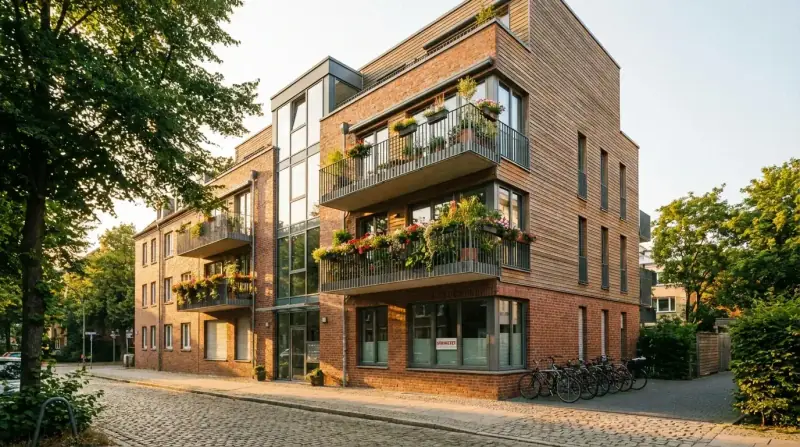
Property as an investment in Germany: yield, AfA, tenancy law, exit
Updated: 2026-09-15 · Reading time: 16 min · ImmoLens editorial team
Editorial & transparency
This guide was written by the ImmoLens editorial team and last reviewed on 2026-09-15. The information is for orientation and does not replace legal, tax or financial advice.
Property as a capital investment has been popular in Germany for decades, and for good reason. Protection of real assets against inflation, predictable rental income and tax advantages make rented-out property a cornerstone of many wealth strategies. But not every property is automatically a good investment. This guide shows what really matters.
1. Why property as a capital investment?
Compared with shares, bonds or gold, rental property offers several unique advantages:
- Regular income – monthly rent as a predictable cash flow
- Inflation protection – historically, rents and property values rise with inflation
- Leverage-Effekt (leverage effect) – debt financing lets you leverage the return on equity
- Tax advantages – depreciation (AfA), income-related expenses and interest deduction reduce your tax burden
- Value appreciation – in good locations, property values rise significantly over the long term
- Real asset – physical ownership, not dependent on individual companies
2. The most important yield metrics
To be able to compare different properties, you need three metrics:
| Metric | Formula | Guide value |
|---|---|---|
| Gross Mietrendite (rental yield) | Annual net rent ÷ purchase price | ≥ 5 % |
| Net Mietrendite | (Annual net rent − costs) ÷ total investment | ≥ 3.5 % |
| Kaufpreisfaktor (price-to-rent multiple) | Purchase price ÷ annual net rent | ≤ 25× |
Total investment = purchase price + Kaufnebenkosten (ancillary purchase costs). Costs = non-apportionable running costs + maintenance + vacancy. Kaufpreisfaktor: up to about 25× is still defensible, from 30× onwards it gets critical.
Watch the denominator: the gross yield is measured against the purchase price, which makes it the reciprocal of the Kaufpreisfaktor (1 ÷ 25 = 4 %). The net yield is measured against the total investment, so it includes the ancillary costs. Putting both on the same denominator is how buyers end up comparing offers incorrectly.
3. The Leverage-Effekt: leverage for your return
The Leverage-Effekt is the biggest advantage of property over other forms of investment: as long as the net Mietrendite is above the loan interest rate, borrowed capital increases your personal return on equity.
| Scenario | Equity | Loan | Cash flow | Return on equity |
|---|---|---|---|---|
| 100 % equity | 200,000 € | 0 € | 8,000 € | 4.0 % |
| 50 % equity | 100,000 € | 100,000 € | 4,500 € | 4.5 % |
| 25 % equity | 50,000 € | 150,000 € | 2,750 € | 5.5 % |
Cash flow before repayment and taxes. The return on equity rises, but so does the risk in the event of vacancy or rising interest rates.
4. Tax advantages for landlords
Rental properties offer considerable tax advantages that noticeably improve the after-tax return:
- Depreciation (AfA, Absetzung für Abnutzung) – the largest item, covered in detail in the next section. Note upfront: the AfA amount is not the tax saving. What you save is your personal tax rate applied to that amount, so at 42 % that is 4,200 € on 10,000 € of AfA
- Loan interest – fully deductible as income-related expenses (Werbungskosten), the repayment portion is not
- Maintenance costs – repairs and renovations are immediately deductible (up to 4,000 € net per individual measure)
- Travel costs – trips to the property, administration, visits by tradespeople
- Tax adviser & administration – deductible on a pro-rata basis
- Spekulationsfrist (speculation period) – after a holding period of ten years the profit on sale is tax free (§ 23 EStG, see section 11)
5. AfA in detail: linear, degressive, Sonder-AfA
Depreciation is the only tax advantage that flows to you without a counter-performance: you deduct a loss of value that costs you no cash. Which rate applies depends on the year of completion and on when construction started. § 7 Abs. 4 EStG knows three linear rates:
| Completion of the building | Linear AfA rate | Depreciation period |
|---|---|---|
| before 1 January 1925 | 2.5 % | 40 years |
| 1925 to 31 December 2022 | 2.0 % | 50 years |
| after 31 December 2022 | 3.0 % | 33 years |
The basis is always the building share only. Land does not wear out and is not depreciated. The split of the purchase price and the ancillary costs between land and building therefore belongs in the purchase contract, otherwise the tax office will estimate it, and rarely in your favour.
Degressive AfA for residential buildings (§ 7 Abs. 5a EStG)
For residential buildings whose construction began after 30 September 2023 and before 1 October 2029, § 7 Abs. 5a EStG allows degressive depreciation: 5 percent of the remaining book value, recalculated every year. Switching back to linear depreciation is permitted, and at some point it pays off.
Over the first four years the degressive method therefore yields 55,648 € instead of 36,000 €, so 19,648 € more depreciation volume. At a 42 percent marginal tax rate that is roughly 8,252 € of liquidity that reaches you four years earlier. From year eleven onwards the degressive rate falls below the linear one (8,981 € against 9,000 €), and that is the point to switch at the latest. In sum this is an interest and liquidity advantage, not a gift: the same building is written off either way.
Sonder-AfA for new rental housing (§ 7b EStG)
§ 7b EStG allows an additional special depreciation of up to 5 percent per year, in the year of acquisition or construction and in the three following years. The hurdles are high, and sales brochures like to skip over them:
- Building application after 31 December 2022 and before 1 October 2029 (the earlier window ran from 31 August 2018 to the start of 2022).
- Construction cost ceiling of 5,200 € per m² of living space. If it is exceeded, the benefit falls away entirely, not pro rata.
- The depreciation basis is capped at 4,000 € per m². Building more expensively does not mean depreciating more.
- Effizienzhaus 40 with the sustainability class, evidenced by the Qualitätssiegel Nachhaltiges Gebäude (QNG).
- Ten years of letting. Selling earlier or moving in yourself forfeits the Sonder-AfA retroactively.
| Construction cost of the building (80 × 4,800 €) | 384,000 € |
| Cost ceiling of 5,200 €/m² respected? | yes |
| Basis for the Sonder-AfA (80 × 4,000 €) | 320,000 € |
| Sonder-AfA, 5 % per year, for four years | 16,000 €/year |
| Linear AfA, 3 % of 384,000 € | 11,520 €/year |
| Total AfA in years 1 to 4 | 27,520 €/year |
| Tax saving at a 42 % marginal rate | 11,558 €/year |
Without the Sonder-AfA you would be at 4,838 € of tax saving per year. The advantage of the Sonder-AfA is therefore around 6,720 € per year over four years, 26,880 € in total. After that the volume is used up and the AfA drops back.
6. Location: macro, micro and what is actually measurable
"Location, location, location" is the most useless sentence in the industry, because it never says what to measure. Separate the two levels cleanly. The macro location is the city or the district and decides demand ten years from now. The micro location is the radius of roughly 500 metres around the front door and decides how quickly you find a new tenant in November.
| Level | What you check | Where the number comes from |
|---|---|---|
| Macro | Population projection to 2040, net migration, age structure | Statistisches Bundesamt and the statistical offices of the Länder, Regionaldatenbank |
| Macro | Job density, dependence on a single large employer | Bundesagentur für Arbeit, municipal economic development office |
| Macro | The Bodenrichtwert and its development over the last three surveys | Gutachterausschuss, determined at least every two years, information available to anyone (§ 196 BauGB) |
| Micro | The ortsübliche Vergleichsmiete for exactly this size and fit-out | Qualified Mietspiegel: adjusted every two years, recreated after four, with a statutory presumption of correctness (§ 558d BGB) |
| Micro | Reachability: stop, shops, nursery, primary school, doctor | Walking time in minutes, walked by you, not copied from the Exposé |
| Micro | Nuisances: through road, railway line, industry, planned building on the open space opposite | The municipality's development plan and land use plan, publicly available |
Property
- 2 to 3-room flats are the easiest to let, because the target group is the broadest
- Year of construction 1960 to 1990: often a favourable purchase price, but check the renovation needs and the GEG obligations
- Ground floor and top floor without a lift are harder to let and harder to sell on
- Grundbuch: encumbrances in section II, rights of way, rights of residence, Erbbaurecht (leasehold)
7. Tenancy law as a yield risk
The rent stated in the Exposé is not the rent you are allowed to charge. German tenancy law caps it in three places, and each of those caps can topple a calculation that worked on paper.
Mietpreisbremse (§ 556d BGB)
In areas with a strained housing market, the rent on a new letting may exceed the ortsübliche Vergleichsmiete (customary local comparative rent) by at most 10 percent. Which areas those are is set by the Land governments in a statutory instrument. Any such instrument must expire by 31 December 2029 at the latest. Before you buy, check whether your municipality appears in your Land's ordinance, because the "achievable rent" quoted in an Exposé routinely ignores it.
Kappungsgrenze (§ 558 BGB)
In an ongoing tenancy you may raise the rent by at most 20 percent within three years, and in areas with a strained housing market only by 15 percent. On top of that come waiting periods: the rent must have been unchanged for 15 months, and a year must have passed since the last increase. Anyone buying a flat with a markedly below-market sitting rent and planning to "simply raise it" will need years.
Modernisation levy (§ 559 BGB)
After a modernisation you may raise the annual rent by 8 percent of the costs attributable to the flat. Two brakes apply: the maintenance share has to be stripped out (whatever would have been due anyway does not count), and the monthly rent may not rise by more than 3 € per m² within six years, or only 2 € per m² if the starting rent is below 7 € per m².
| Cost of the measure (share of this flat) | 12,000 € |
| less the maintenance share (30 % here) | −3,600 € |
| costs eligible for the levy | 8,400 € |
| Rent increase: 8 % per year | 672 €/year = 56 €/month |
| Cap (3 €/m² × 70 m²) | 210 €/month, not exhausted |
| Return on your outlay (672 € ÷ 12,000 €) | 5.6 % p.a., amortised after 17.9 years |
The much-quoted "8 percent return" applies only to the costs eligible for the levy. Measured against the money you actually spend, 5.6 percent is left. The increase must be declared in text form and is only owed from the beginning of the third month after the declaration arrives (§ 559b BGB).
And the tenant stays
When you buy a let flat you step into the existing tenancy, sale does not break the lease (§ 566 BGB). Evicting the tenant for personal use is not the point of a capital investment anyway, but even if it were: if the flat was converted into Wohnungseigentum only after it was let, the blocking period of § 577a BGB applies, three years, which Land governments in strained areas may extend by statutory instrument to up to ten years. Several Länder have done so. Check your Land's ordinance, and check the purchase contract for the date of the conversion.
8. WEG risks: maintenance reserve and Sonderumlage
With a condominium you are not just buying a flat, you are buying a share of a building whose renovation other people vote on. The Wohnungseigentumsgesetz names the "accumulation of an appropriate Erhaltungsrücklage (maintenance reserve)" in § 19 Abs. 2 Nr. 4 as part of proper administration. What counts as appropriate is not defined in the statute. A defensible benchmark comes from § 28 Abs. 2 of the Zweite Berechnungsverordnung with its maintenance allowances:
| Age of the building | Benchmark per m² of living space and year | for 70 m² |
|---|---|---|
| up to 22 years | 7.10 € | 497 €/year |
| 22 to 32 years | 9.00 € | 630 €/year |
| over 32 years | 11.50 € | 805 €/year |
With a lift, 1 € per m² and year is added. The figures of the II. BV cover the maintenance of the whole building, not only the common property, and they are a ceiling for a calculation, not a mandatory contribution. They still work as a yardstick for a reserve, because they are the only official number in this field.
Practice almost always falls short. Work the real case through: a building from 1985 with twelve flats and 900 m² of living space sets aside 0.40 € per m² and month. After 15 years the reserve holds 64,800 €. Then the roof needs replacing, at 180,000 €. That leaves 115,200 € missing, and the association raises it through a Sonderumlage: a resolution on additional advance payments under § 28 WEG, allocated by co-ownership shares. On your 70 m² that is 7.78 percent, so roughly 8,960 €, due within a few instalments.
9. Typical mistakes with capital investments
| Mistake | Why it is a problem |
|---|---|
| Looking only at the gross Mietrendite | Hides running costs, vacancy and maintenance |
| Purchase price too high (multiple > 30×) | Cash flow almost always negative, a pure bet on value appreciation |
| Underestimating the renovation needs | GEG renovation obligations, roof, heating, quickly 50,000+ € |
| Too little equity | High interest burden, negative cash flow, no buffer |
| Emotional purchase | “A lovely flat” ≠ a good capital investment, the yield decides |
| Overestimating the tax advantage | AfA improves things, but does not rescue a poor yield |
10. Sample calculation: a flat as a capital investment
3-room flat in Karlsruhe, 220,000 € purchase price
11. The exit: the ten-year rule and the three-object limit
The sale decides the total return, and it is the point where most calculations collide with the tax office for the first time. Two rules have to be understood before you buy, not before you sell.
The ten-year period (§ 23 EStG)
The gain from selling a let property is a private disposal transaction if no more than ten years lie between acquisition and disposal. In that case it is taxed at your personal rate. Once the ten years have passed, it is tax free. What counts are the dates of the notarised contracts, not the handover and not the entry in the land register. If you bought on 3 February, the earliest tax-free sale is on 4 February ten years later.
Owner-occupied property is exempt if it was used for your own residential purposes in the year of sale and in the two preceding years. For a capital investment that only matters if you move in before selling. There is also an exemption threshold across the board: if the total gain from private disposal transactions in a calendar year stays below 1,000 €, it is tax free.
Commercial property trading and the three-object limit
Anyone buying and reselling several properties in quick succession will at some point stop being treated as a private investor and start being treated as a trader. The threshold appears in no statute, it is judge-made law: the Grand Senate of the Bundesfinanzhof confirmed it in its decision of 10 December 2001 (GrS 1/98). Rule of thumb: selling more than three objects within roughly five years of acquiring or building them is, as a rule, commercial property trading.
The consequences are unpleasant and hit every object retroactively: the ten-year rule of § 23 EStG no longer protects you, every gain is taxable. Gewerbesteuer (trade tax) is added. The properties become current assets, which removes the AfA. And the five-year period is not a hard edge: in individual cases the Bundesfinanzhof also pulls in sales up to ten years after acquisition, particularly for people working in the property industry.
12. Checklist: assessing a property as a capital investment
- Gross Mietrendite ≥ 5 % (or a deliberate bet on value appreciation)☐
- Kaufpreisfaktor ≤ 25×, above that the cash flow gets difficult☐
- Renovation needs and GEG obligations checked☐
- Mietspiegel and vacancy rate researched☐
- Equity at least the ancillary costs + 10 % of the purchase price☐
- Cash flow calculation incl. interest, repayment, maintenance☐
- Tax impact (AfA, income-related expenses) calculated☐
- Minutes of the last three owners' meetings read☐
- Level of the Erhaltungsrücklage requested and checked against the building's age☐
- Mietpreisbremse and Kappungsgrenze checked for the municipality☐
- Bodenrichtwert trend reviewed across three surveys☐
- Purchase price split between land and building (the AfA basis)☐
- Exit timed against the ten-year rule of § 23 EStG☐
Calculate the yield right away
Our yield calculator works out the gross and net Mietrendite, the cash flow and the return on equity, in seconds.
Open the yield calculatorThe next step for your property
Check your listing for free with AI: renovation costs, funding programmes and risks in a few minutes. Start your analysis, or use the free tools: Closing cost calculator, Budget calculator, Viewing checklist.