All guides · Practice
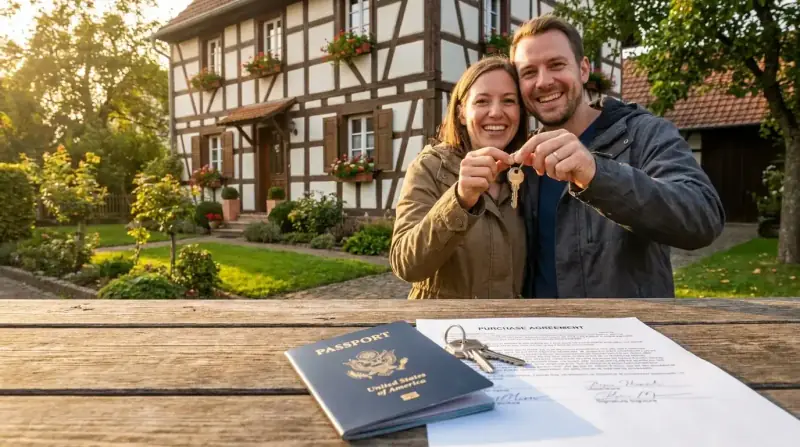
How to buy a house in Germany as a foreigner (2026)
Updated: 2026-07-28 · Reading time: 15 min · ImmoLens editorial team
Editorial & transparency
This guide was written by the ImmoLens editorial team and last reviewed on 2026-07-28. The information is for orientation and does not replace legal, tax or financial advice.
Can you buy a house or a flat in Germany without a German passport? Yes, without any restriction. German law does not tie property ownership to citizenship or to a residence permit: EU citizens, non-EU citizens and even buyers who live abroad can all own German real estate outright, including the land it stands on. There is no approval procedure of the kind Switzerland, Denmark or parts of Austria apply to foreign buyers. What actually decides whether the purchase works is not your nationality, it is financing, the notary process and the taxes. This guide walks through all three in English.
1. How buying property works in Germany
The German process differs from the UK or US model in one central point: nothing is binding until both sides sign in front of a notary. A signed offer, a handshake, even a paid reservation fee create no obligation to sell or buy. The typical sequence:
- Find the property and view it, usually via the big portals or an estate agent (Makler).
- Get a financing certificate (Finanzierungsbestätigung) from a bank. Sellers take offers seriously only with one.
- The notary drafts the contract. The notary (Notar) is a neutral state-appointed lawyer, not your advocate and not the seller's. When a business sells to a consumer, the law requires that you receive the draft at least two weeks before signing (§ 17 Abs. 2a BeurkG), so you have time to read and ask.
- The notary appointment. The notary reads the entire deed aloud and must be satisfied that you understand it. If your German is not sufficient, § 16 BeurkG requires a translation, in practice a sworn interpreter, whom you pay (typically a few hundred euros). Some notaries in the larger cities certify directly in English.
- Priority notice and payment. After signing, the notary registers an Auflassungsvormerkung, a priority notice in the land register that blocks the seller from selling twice. Only when it is registered and the other conditions are met does the notary tell you to pay. Payment goes directly to the seller's account; an escrow account with the notary (Notaranderkonto) is the exception, not the rule.
- Keys at payment, ownership later. Possession, use and risk transfer when the price is paid. The formal change of ownership in the Grundbuch (land register) follows weeks to months later, once the transfer tax is paid. That delay is normal and the priority notice protects you throughout.
2. What it costs on top of the price
Germany's closing costs are high by international standards: 5.5 to 12.1 percent of the purchase price come on top, depending on the federal state and on whether an agent is involved. They must be paid from your own funds, because German banks do not finance them.
| Item | Rate | Notes |
|---|---|---|
| Grunderwerbsteuer (transfer tax) | 3.5 to 6.5 % | Set by the federal state: 3.5 % in Bayern, 6.5 % in Brandenburg, NRW, Saarland, Schleswig-Holstein |
| Notary | about 1.5 % | Statutory fee scale (GNotKG), not negotiable |
| Land register (Grundbuch) | about 0.5 % | Registration of ownership and mortgage |
| Estate agent (Makler) | typically 3.57 % | Since 2020 the commission is shared between seller and buyer (§§ 656a to 656d BGB); the buyer pays at most half |
On a €400,000 flat the difference between Bayern (3.5 %) and Nordrhein-Westfalen (6.5 %) is €12,000 in transfer tax alone. The full breakdown with worked examples is in the closing-costs guide, and the free closing-costs calculator computes the exact figure for every federal state.
3. Getting a mortgage as a foreigner
This is where nationality-adjacent reality kicks in. Banks do not care about your passport, they care about where your income arises and where you live. Three situations, three very different outcomes:
| Your situation | What banks typically offer |
|---|---|
| You live and work in Germany | Standard conditions, same as for German citizens. A permanent residence title and a permanent employment contract make approvals noticeably easier; with a temporary permit some banks limit the loan term or ask for more equity. |
| EU citizen, income in another EU country | Possible with many banks, but expect stricter equity requirements and paperwork on the foreign income. |
| Non-resident, income outside the EU | The hardest case: many banks decline, the rest commonly ask for 30 to 40 percent equity plus all closing costs. Currency risk between your income and the euro loan is your problem, not the bank's. |
The German-specific mechanics of the loan itself are the same for everyone: fixed-rate periods of 10 to 15 years (average 10-year rates in 2026: 3.2 to 3.8 percent), a repayment rate (Tilgung) you should set at 2 percent or higher, and a negotiated right to extra repayments (Sondertilgung). All of it is explained in the mortgage guide and the equity guide.
4. Subsidies: KfW does not ask about your passport
Germany's state development bank KfW funds owner-occupiers with low-interest loans and grants, and the programmes are tied to the property and its use, not to citizenship. If you buy in Germany and live in the property, you can apply like anyone else. The application always runs through a bank operating in Germany, never directly, so in practice you need a German financing bank anyway. Which programme fits which case (KfW 124, the family programme 300, the Jung kauft Alt programme 308 with loans up to €180,000 since 3 August 2026, and the renovation programme 261) is covered in the KfW guide in English.
5. Taxes: while you own, when you rent out, when you sell
- While you own: the annual Grundsteuer (property tax), set by the municipality. For a typical family home it commonly runs to a few hundred euros per year.
- If you rent the property out: the rental income is taxable in Germany even if you live abroad (limited tax liability). Most countries' double-taxation treaties assign the taxing right to Germany as the country where the property sits; check the treaty with your home country.
- When you sell: § 23 EStG sets the famous ten-year rule. Sell a rented property within ten years of buying and the gain is taxed at your income tax rate. Hold it longer than ten years and the gain is tax-free. Owner-occupiers are better off still: living in the property in the year of sale and the two preceding years makes the sale tax-free regardless of the holding period.
6. The vocabulary you will actually encounter
| German term | What it means |
|---|---|
| Exposé | The sales brochure of the property |
| Grundbuch | The land register: who owns, and which debts sit on the property |
| Auflassungsvormerkung | Priority notice protecting you between signing and registration |
| Grunderwerbsteuer | One-off property transfer tax, 3.5 to 6.5 % by state |
| Hausgeld | Monthly service charge in a condominium building |
| Teilungserklärung | Declaration of division: what belongs to your flat, what is shared |
| WEG | The owners' association of a condominium building, with its own meeting minutes worth reading |
| Energieausweis | The energy certificate; classes A+ to H, explained in the Energieausweis guide |
| Vorfälligkeitsentschädigung | Prepayment penalty if you exit a fixed-rate loan early |
7. The five mistakes foreign buyers actually make
- Budgeting like at home. Forgetting the 5.5 to 12.1 percent closing costs, which banks will not finance.
- Treating the notary as their lawyer. The notary is neutral. Nobody in the room negotiates for you; if you want advocacy, bring your own adviser.
- Signing without understanding. Skipping the interpreter to save a few hundred euros on a six-figure contract. § 16 BeurkG exists for a reason: use it.
- Paying before the appointment. Reservation fees, "deposits", advance payments: none of these are part of a proper German purchase.
- Ignoring the building's paperwork. For flats: the Teilungserklärung, the last owners' meeting minutes and the maintenance reserve tell you about special levies long before the seller does. What to check on site is in the viewing guide.
8. Frequently asked questions about buying as a foreigner (FAQ)
Can foreigners buy property in Germany without being a citizen?
Yes. Houses, flats and building plots follow the same rules for every buyer, with or without a German or EU passport. The one niche exception applies to everyone equally: the sale of agricultural and forestry land needs an approval under the Grundstückverkehrsgesetz (§ 2 GrdstVG), for German buyers just as for international ones. For normal residential property, no authority reviews who you are before you may own it.
How do you buy a house in Germany as a foreigner?
In five steps, none of which depend on your nationality: secure a financing certificate, receive the notary's draft contract, sign at the notary appointment, wait for the priority notice, then pay. If your German is not sufficient, § 16 BeurkG requires a translation, in practice a sworn interpreter whom you pay. Section 1 above walks through each step; budget the closing costs of 5.5 to 12.1 percent from the start, because no German bank finances them.
Can Americans buy property in Germany?
Yes, under the same rules as everyone else. This includes US citizens stationed in Germany and buyers who stay in the US. What differs is the mortgage file: a US salary without German residence puts you in the hardest financing category, where banks that lend at all commonly want 30 to 40 percent equity. Americans living and working in Germany are treated like any local applicant, and owner-occupiers can use KfW programmes; the KfW guide explains them in English.
Does buying property in Germany get you residency?
No. The land register and the immigration office are separate worlds: the purchase requires no residence permit, and it creates none. Unlike some EU countries, Germany offers no residence permit in exchange for a property investment. If you plan to live in the property, sort out your residence status through immigration law first, also because a permanent title noticeably improves your mortgage conditions.
Can I get a home loan in Germany as a foreigner, and at what rates?
Yes, and the rate itself does not depend on your passport: 10-year fixed loans average 3.2 to 3.8 percent in 2026. Expect German specifics: fixed periods of 10 to 15 years instead of 30, a repayment rate (Tilgung) of at least 2 percent, and extra repayment rights (Sondertilgung) only if negotiated. The number of willing banks shrinks the weaker your ties to Germany are; section 3 shows the three financing categories, and the mortgage guide covers how to compare offers.
How high is property tax in Germany for foreigners?
Exactly as high as for Germans; no surcharge exists for foreign owners. Two taxes matter: the one-off transfer tax of 3.5 to 6.5 percent of the purchase price, depending on the federal state, and the annual municipal Grundsteuer, typically a few hundred euros for a family home. Rental income from a German property is taxable in Germany even if you live abroad, and on a later sale the ten-year rule of § 23 EStG decides whether the gain stays tax-free. The closing-costs calculator shows the transfer tax for every state.
Which documents do you need as a foreign buyer?
For the purchase itself only a valid passport, since the notary must identify you. The real paperwork sits in the financing: banks ask for payslips or, if self-employed, around two years of tax returns, proof of equity and, from non-residents, certified translations of foreign income documents. From the seller you are entitled to key documents: the Energieausweis must be presented at the viewing at the latest (§ 80 Abs. 4 GEG), and for a flat, ask for the Teilungserklärung and the recent owners' meeting minutes before you sign.
Sources and status
Status: 19 July 2026. Legal anchors checked against the statutory texts at gesetze-im-internet.de (§ 16 BeurkG, translation at the notary) , § 17 BeurkG (two-week draft period) , § 23 EStG (ten-year rule) and §§ 656a ff. BGB (agent commission) . The notary process is described by the Federal Chamber of Notaries at notar.de . Transfer tax rates are state law and current as of July 2026. Bank lending practice for non-residents varies by institution; the equity figures above describe the common range, not a guarantee.
German Exposé, English analysis
ImmoLens reads the German property brochure and gives you the full analysis in English: price assessment, renovation costs, subsidies and the questions to ask at the viewing.
Analyse an ExposéThe next step for your property
Check your listing for free with AI: renovation costs, funding programmes and risks in a few minutes. Start your analysis, or use the free tools: Closing cost calculator, Budget calculator, Viewing checklist.